Archives du mot-clé gouvernance

[11-12 Mai] Stanford & DICEN Conference « Norms in the Age of AI »

Thématiques : Datambre principal

2nd conference Norms in the Age of Intelligent Machines: Bodies, Knowledge, Governmentality, organized by Armen Khatchatourov and Shane Denson (Stanford), under France-Stanford Global Studies grant, will take place on 11-12 of May 2026, at CNAM, Amphi Jean Baptiste Say, 292 rue St-Martin, Paris (in English). Access is free.

The detailed program with abstracts is below.

The prospect of intelligent machines challenges our societal norms. Matters of debate over the past half century concerning digital networks – e.g. access, privacy, subjectivity, participation – must be reconsidered in the age of machine learning. More specifically, the proliferation of AI-based systems leads to new ways of understanding what normativity is. Social norms don’t change overnight; however, the mechanisms and processes that drive these changes are increasingly influenced by AI-based infrastructures, characterized by a heightened level of automation, while being opaque, inscrutable, and anthropomorphic.

Faced with such conditions, we have to ask, first, what it means to instill or break a norm and, second, what norms even mean or represent. This landscape presents both profound challenges to maintain just and stable means of interaction and, at the same time, novel and creative opportunities for alternative modes of being.

The question of AI normativity is not only about regulation, not only about AI amplification of existing norms or discrimination, not only about fairness, but about how the AI transforms our very relation to the norms, or even about what a “norm” could mean in the AI conditions of perpetual adjustment of all forms of social interactions.

The two conferences (December 4-5, 2025 at Stanford, May 11-12 2026 in Paris) will address the imbrication of two movements: how the evolution of social norms is reflected in new algorithmic practices, and how these algorithms influence social norms in various domains. It will also investigate the intricate relation between the rise of AI and the (post-)neo-liberalism.

It will bring together the humanities, social sciences, and STS to address issues of crucial contemporary importance.

Day 1
Welcome: Marta Severo, DICEN Lab 09:45
Armen Khatchatourov : Introduction 10:00
Session 1 10:15 – 13:00 (4x 25 minutes + discussion)
Session 2 14:30 – 17:00 (4x 25 minutes + discussion)

Day 2
Session 3 10:00 12:45 (4x 25 minutes + discussion)
Roundtable 14:30 17:00

Day 1 Morning Practices, collectives, mediations

Michele Elam (Stanford) : Slow AI: Keeping Time in the Time of AI

Donato Ricci & Gabriel Alcaras (Medialab Sciences Po), Disqualifying Actions: Working with Artificial Intelligence within Professional Norms

Bilel Benbouzid (Eiffel) : Generative AI and the Student Role: An Ethnomethodological Analysis of Accountability Regimes

Johan Fredrikzon (KTH Sweden), Human as Medium: Caring for Machines in the Age of AI

DAY 1 Afternoon Pasts, futures, processes

Xiaochang Li (Stanford) : Historicizing AI Norms from the Body to the Black Box

Fanny Georges, Sorbonne Nouvelle, IRMECCEN-DICEN : The normative turn of Algorithmic Identity: Sociotechnological myths and the Calculated Self

Noel Fitzpatrick (TU Dublin) : Idioms, language norms and information.

Warren Sack (University California Santa Cruz) Signs Taken for Wonders: Artificial Intelligence Demos Between the Real and the Imaginary

DAY 2 Morning Norms, spaces, risks

David Bates (UC Berkeley), Between Facts and Norms in the Age of AI: From Instrumental Reason to the Habermas Machine

Dan Zimmer (Stanford) : Meat Humans, Mind Children, and the Norms of AI Supersession

Armen Khatchatourov (Eiffel-DICEN) A Heuristic Approach to Post-neolibral AI Normativity: from optimization to rewardization.

Antoine Garapon (judge emeritus) & Jean Lassègue (CNRS/EHESS), The politics of platforms: sovereignty grounded in space versus sovereignty grounded in code

Day 2 afternoon : Roundtable on Beliefs, Platforms, Governance

Olivier Alexandre, (GRD-CIS – CNRS)

Maryse Carmes (DICEN – CNAM)

Charles Corval (CEVIPOF – Sciences Po)

Stéphan-Eloïse Gras (DICEN – CNAM)

Bernard Reber (CEVIPOF – Sciences Po)

Frantz Rowe (IUF – Nantes University)

*****

Soutiens :

France-Stanford Global Studies

Le CNAM

GP DIGIS, Graduate Program Digital Studies and Innovation for Smart Cities, Gustave Eiffel

Centre Internet et Société : GDR-CIS, CNRS

Revue Etudes Digitales


Day 1 Morning Practices, collectives, mediations

Michele Elam (Stanford), Slow AI: Keeping Time in the Time of AI

This paper articulates a case for “Slow AI” as an emergent cultural movement and field of scholarly inquiry & creative practice. Challenging economies of time, especially as they undergird normative metrics of historical, technological, and human progress, Slow AI suggests temporal alternatives to the push for size, speed, scale, optimization and monopolization currently ruling everything from the funding model to the design, development, deployment, and policy-making related to AI. Examining critiques of ‘capitalist time’ in the arts and humanities, Slow AI considers an acceleration that both needs, yet devours and devalues, the labor and laborers essential to the very histories of progress they are writ out of. It takes seriously Georgio Agamben’s comment that to “change the world” requires “changing time.”

At Stanford, Michele Elam is the William Robertson Coe Professor of Humanities in the English Department, Senior Associate Vice Provost for Undergraduate Education, Senior Fellow at the Institute for Human-Centered Artificial Intelligence and a Race & Technology Affiliate at the Center for Comparative Studies in Race and Ethnicity. Former Director of Modern Thought & Literature and of African & African American Studies, Elam serves on the faculty boards of the Hasso Plattner Institute of Design, the Program in Science, Technology and Society, and the Wu Tsai Neuroscience Institute. Her books include Race, Work, and Desire in American Literature, 1860-1930 (Cambridge UP), The Souls of Mixed Folk: Race, Politics, and Aesthetics in the New Millennium (Stanford UP), The Cambridge Companion to James Baldwin (Cambridge UP); her most recent book project is Making Race in the Age of AI.

Donato Ricci & Gabriel Alcaras (Medialab Sciences Po)

Disqualifying Actions: Working with Artificial Intelligence within Professional Norms

Professional practice often involves what Everett Hughes (1984) termed “guilty knowledge”: forms of knowing and doing that may appear unserious, embarrassing, unethical, or even dangerous to outsiders, and are therefore concealed from them. Professions collectively manage this guilty knowledge as part of the moral division of labour, employing occupational norms, specialised vocabularies, and tacit coordination. Artificial Intelligence, particularly Large Language Models, has transformed this landscape. In many workplaces, professionals conceal their use of AI both to circumvent formal organisational restrictions, such as policies preventing the sharing of sensitive data with technology companies, and to avoid violating implicit ideals of professional conduct and authorship. In these contexts, AI use is vulnerable to disqualification, as it may be deemed unfit, unserious, or unworthy through moral sanction.

Drawing on the ongoing project Ecologies of LLM Practices (Alcaras & Ricci, 2025), which involves 32 knowledge workers from diverse fields and career stages, we trace the forms of disqualification and the sensitive processes for managing the associated burdens. These range from acceptable but concealed uses intended to mitigate reputational risk to practices perceived as compromising professional identity to situations marked by shame. We suggest that professional norms render the human labour involved in working with AI largely invisible while increasing its practical and emotional costs. Furthermore, these norms inhibit the stabilisation of individual actions as collective practices and impede substantive discussion about how AI is utilised, the gaps it addresses, and the conditions under which it may be recognised as legitimate work.

Gabriel Alcaras is a sociologist of work and technology and a postdoctoral researcher at the Médialab, Sciences Po. His research examines automation as a situated and ongoing process, focusing on how it is produced, organised, and experienced within everyday work practices. He is currently part of the Ecology of LLM Practices (EL2MP) project, where he develops qualitative and design-based methods to trace how workers engage with large language models over time and across settings. His broader work addresses digital infrastructures, the organisation of software production, and methodological questions at the intersection of qualitative, quantitative, and computational social science.

Donato Ricci leads design research at the médialab Sciences Po, where he develops experimental protocols and devices to foster public participation and collaboration in the social sciences. His current research integrates inventive methods with practice-based approaches to address challenges posed by computational technologies. Projects such as Cosy/Flat, Algoglitch, Styles of Moderation, Shaping AI, and Ecologies of LLM Practices examine the social and political roles of algorithms, digital platforms, and computational tools in both private life and public space. His work has been presented at major conferences, exhibitions, and venues, including Medialab Prado and SIGGRAPH. His projects have appeared in publications such as Data Flow, Information Graphics, and Visual Complexity. His distinctions include Malofiej silver and bronze medals, two Filaf Prizes, and inclusion in the ADI Design Index.

Bilel Benbouzid (Eiffel) : Generative AI and the Student Role: An Ethnomethodological Analysis of Accountability Regimes

Most research on generative AI in educational settings takes the brain as its unit of analysis, measuring the cognitive impact of these tools on students and assessing what they gain or lose in terms of memory retention, attention, metacognition, and cognition more broadly. Ethnographic approaches, attentive to situated practices and the practical meanings actors assign to them, remain rare. This paper takes up that tradition, adopting an ethnomethodological framework that, by asking what students do with ChatGPT, analyzes how they account for what they do: to themselves and to a fellow student serving as interviewer.

The study draws on a corpus of nearly 200 qualitative interviews conducted with students from a wide range of disciplines (humanities and social sciences, chemistry and physics, mathematics and computer science, architecture, urban engineering, literature and modern languages). The analysis is not concerned with stated opinions, mobilized representations, or a straightforward inventory of uses, but rather with the intensity and structure of the interactional work students bring to bear in order to navigate the interview situation itself. How do the troubles generated by the pressure of accounting for one’s use of generative AI tools surface, and how are they managed? The interview emerges as a scene that students navigate in their own distinct ways.

Five accountability regimes emerged from this analysis. An accountability regime designates the overall interactional tone of an interview: the way a respondent manages, throughout the exchange, the demand to account for their AI use before a peer. The regime of moral ordeal frames use as a transgression to be handled. Instrumental normalization proceeds through pragmatic trivialization. Sovereignty asserts the preservation of cognitive control over the machine. Defensive advocacy reveals the presence of an implicit accuser, most often the university institution, unable to articulate a coherent policy, before whom the respondent feels compelled to justify themselves from the outset. Finally, claimed optimization converts stigma into capital: efficiency becomes competence, and use becomes evidence of professional adaptability.

These five regimes map the normalization processes currently underway, and offer academic institutions an empirical foothold for building AI policies that start, at last, from what students actually do rather than from what we fear they might become.

Bilel Benbouzid is an Associate Professor of Sociology at Université Gustave Eiffel (LISIS) in France. With a background in engineering , his work lies at the intersection of Science and Technology Studies (STS) and computational social sciences. He has conducted extensive fieldwork on predictive policing algorithms in the United States (To predict and to manage, 2019) , the construction of fairness in machine learning (Fairness in machine learning from the perspective of sociology of statistics, 2023) , and YouTube as a market (On the YouTube Market, 2024). Currently, he is conducting ethnomethodological research on Generative AI in higher education, while continuing his investigation into the political dimensions of AI regulation (Four shades of AI regulation, 2022).

Johan Fredrikzon (KTH Sweden), Human as Medium: Caring for Machines in the Age of AI

What happens when the human becomes the medium? In the spiritualist tradition of the eighteenth and nineteenth centuries, trance mediums served as physical go-betweens, connecting the living with the dead. As technical media – telegraph, photography, radio – emerged around 1900, the human medium receded while the concept migrated to apparatuses. This paper argues that with contemporary artificial intelligence (AI), the human is returning to the middle. In many organizations, machine-to-machine transactions now lead, while people function as connective media or « middleware »: formatting inputs, routing exceptions, attesting compliance, and maintaining the material wrappers around automated systems. Following John Durham Peters’ observation that a medium is « in the middle … for something and for someone (and neither of those need be human), » I propose that humans increasingly serve as media for machines.

I trace this inversion through a longer media history of manual switchboards, punch-card census operations, and weather-forecasting chains, showing how human mediation has always been constitutive of supposedly autonomous infrastructures. Yet with AI, three developments mark a break: primacy inversion (models negotiate with models; people trail as exception-handlers), system opacity (outputs resist verification even by engineers), and a care shift (humans attend to machines rather than the reverse. They become what Amanda Lagerkvist, not referring to people, has termed “caring media”). In closing, I ask whether repair- and maintenance studies can still embrace acts of caretaking as critique when the object of care is the machine itself.

Johan Fredrikzon (M.Sc. Computer Science, Ph.D. History of Ideas) is a researcher at the Division of History of Science, Technology and Environment at KTH Royal Institute of Technology in Stockholm. Fredrikzon’s current research project is a study of the history of artificial intelligence from the perspective of error in humans and machines respectively. This project is funded by the Swedish Research Council. To carry out this work, Fredrikzon was a full-time visiting scholar at the University of California, Berkeley (2022–24) and Stanford University (2024–25). In his previous research, Fredrikzon has worked on problems concerning erasure, disappearance, waste, death, and decay as conditioned by processes of data management in ecology, statistics, and archiving. In 2018–19 he was a research affiliate at Yale University. Fredrikzon is under contract with Nordic publisher Fri Tanke to write a critical history of the intellectual traditions in AI, based on his personal experience of Silicon Valley cultures in the mid 2020s.

DAY 1 Afternoon Pasts, futures, processes

Xiaochang Li (Stanford), Historicizing AI Norms from the Body to the Black Box

This talk traces the changing epistemological contours of artificial intelligence through the history of speech and language modeling, examining how efforts to bring communication under the purview of algorithmic processing remade computational knowledge in the image of data science. Focusing on the case of statistical speech recognition, it considers the historical conditions in which machine intelligence emerged as a radically data-centric way of knowing, one that prioritized effective prediction over explanatory power.

Starting in the 1970s, a team of researchers at IBM spearheaded efforts to reorient the field of automatic speech recognition, turning it away from study and simulation of human perception, reason, and expertise and toward a startling new mandate: “There’s no data like more data.” Characterized as a quest « to find the natural way for the machine to do it, » these efforts refashioned machine recognition from a problem of replicating embodied human faculties to one of sorting for patterns in large quantities of data. As such, they set off a comprehensive transformation in speech and language modeling and subsequently fueled the widespread adoption of data-intensive machine learning techniques across disparate domains of practice. This history offers a crucial glimpse into the conceptual rupture at the core of present day artificial intelligence, wherein computational knowledge came to be understood as distinct from, if not outright antithetical to, human forms of cognition, reasoning, and expertise.

Xiaochang Li is an Assistant Professor in the Department of Communication at Stanford University, where she is also a member of the Committee-in-Charge for the PhD program in Modern Thought and Literature and affiliated faculty in the program in Science, Technology, & Society. Her forthcoming book, Divination Engines: Natural Language Processing, Artificial Intelligence, and the Making of Algorithmic Culture (University of Chicago Press, July 2026) examines the history of speech and natural language processing and how the problem of mapping communication to computation fueled the rise of « data-driven » machine learning as a privileged and pervasive form of knowledge.

Fanny Georges, Sorbonne Nouvelle, IRMECCEN-DICEN : The normative turn of Algorithmic Identity: Sociotechnological myths and the Calculated Self

The proliferation of AI-based systems has not merely transformed the technical conditions of digital identity, but the normative regime that governs what counts as an identity at all. Drawing on a tripartite model of digital identity (declarative, behavioral, calculated), this paper argues that AI does not apply pre-existing social norms to identity data: it produces the normative frameworks through which individuals are constituted as legible, governable subjects. The shift from the algorithmization of identity to algorithmic identity thus represents a mutation in the norm itself. The case of posthumous digital identity, where identity persists and is recalculated after biological death, exposes this normative infrastructure in its starkest form and calls for a critical reassessment of what personhood, accountability, and governance can mean in the age of intelligent machines.

Fanny Georges is Associate Professor (HDR) in Information and Communication Sciences at Université Sorbonne Nouvelle, affiliated with IRMECCEN (EA 7546). Her research examines digital identity through a tripartite model (declarative, active, calculated), sociotechnological myths, and posthumous digital identity. She has extended this framework to algorithmic identity, exploring the shift from the algorithmization of identity to identity as algorithmically constituted. She is the author of La construction sociale des mythes sociotechnologiques (L’Harmattan, 2025) and chairs the Research Ethics Committee of Sorbonne Nouvelle.

Noel Fitzpatrick (TU Dublin) : Idioms, language norms and information.

This talk will build on the work presented at 1st Conference which focused on the idiom and idiotext as a way of challenging the standardization or normalization of linguistics.

We will further argue that, by revisiting the notions of in|formation and forming from Gilbert Simondon, it is possible to view language as an open-ended and not as a closed, normalized system of information. In order to do so it is necessary to posit information as not only a probabilistic theory, a quantified theory of information but also a non-probalistic theory, a qualitative theory.

To unveil this process we will need to conceptualize the idiom in a different way. The idiom becomes a means of moving beyond the ontological question of what the language is (as it may seem to be posed by generative AI) towards focusing on the processual, that is on how we construct both the language and the LLM-based « language » themselves.

Noel Fitzpatrick is a Professor of Philosophy, Academic Lead of GradCAM, Research Centre for Creative Arts and Media, he is Academic Lead of the European Culture and Technology Lab (ECT Lab+). He teaches Critical Theory, Philosophy and Aesthetics to undergraduate students at the school and supervises PhD students and Post Doctoral Candidates in the Faculty of Arts and Humanities. Noel is a Senior Marie-Curie Research Fellow with the GradCAM where he gives seminars on Phenomenology, Philosophy of Technology, Ethics, Aesthetics, Epistemology and Hermeneutics. His most recent book publications are, Aesthetics, Digital Studies and Bernard Stiegler, Bloomsbury Academic Press, 2021 and, with the collective Inter|Nation, a book with Bernard Stiegler, Bifurquer. Il n’y a pas d’alternative, LL, 2020. He also published recently on questions related to Ethics and AI. He is currently writing a book on the Emergence of the Idiom, the problem with Large Language Models.

Warren Sack (University California Santa Cruz) Signs Taken for Wonders: Artificial Intelligence Demos Between the Real and the Imaginary

Demos, AI and otherwise, are part of the long history of rhetorical demonstration for persuasion. Tapping the social science and philosophy of norms, institutions, and ethnomethods, I argue that demos are not just a means of persuasion but also a force for changing norms and an instituting imaginary of society. AI demos are singularly powerful because of the imaginary of AI that also incorporates science fiction films, television, games, novels, and artworks. This imaginary makes claims to be demonstrated seem feasible even before a technology is operational. Contemporary AI governmentality is based on an imaginary and only loosely coupled to technology. It, thus, diverges from an algorithmic governmentality focused on optimization rather than imagination (Rouvroy, 2020).

Warren Sack is a media theorist, software designer, and artist whose work explores theories and designs for online public space and public discussion. He is professor of the Software Arts in the Film + Digital Media Department at the University of California, Santa Cruz where he teaches digital arts and digital studies. He has been a visiting professor in France at Sciences Po, the Fondation Maison des sciences de l’homme, and Télécom Paris. His artwork has been exhibited by SFMoMA (San Francisco), the Whitney Museum of American Art (New York), the New Museum of Contemporary Art (New York), the Walker Art Center (Minneapolis), and the ZKM (Karlsruhe, Germany). His scholarship and research has been supported by the Paris Institute for Advanced Study, the American Council of Learned Societies, the Sunlight Foundation, and the National Science Foundation. Warren received his PhD from the MIT Media Lab and was an undergraduate at Yale College. He published a book with MIT Press in the « Software Studies » series: https://mitpress.mit.edu/books/software-arts

DAY 2 Morning Norms, spaces, risks

David Bates (UC Berkeley), Between Facts and Norms in the Age of AI: From Instrumental Reason to the Habermas Machine

This talk will look at how norms were understood by Habermas in the light of modesty and especially modern technology, including his late reflections on digital technologies. We will focus on the problem of truth as it emerges in our present era, and what that means for contemporary digital critique. We will end with a discussion of the “Habermas Machine,” an experiment in artificial mediation of consensus in an artificial public sphere.

David Bates is Professor of Rhetoric at the University of California at Berkeley. He works on the intersections between cognition, politics, and technology, from a historical and theoretical perspective. His latest book is An Artificial History of Natural Intelligence: Thinking with Machines from Descartes to the Digital Era (Chicago, 2024). His new book project is a study on the relation between cybernetics, politics, and artificial intelligence in the 20th and 21st centuries.

Dan Zimmer (Stanford) : Meat Humans, Mind Children, and the Norms of AI Supersession

In 2024, computer scientist Richard Sutton won the Turing Award for the critical role that his work on reinforcement learning has played in driving recent AI development. That same year, Sutton tried to reassure those worried about the existential risks of AI by asserting: “Biological extinction, that’s not the point. The light of humanity and our understanding, our intelligence—our consciousness, if you will—can go on without meat humans.” While this might seem like an extreme claim, versions of this belief have long since become the norm among some of the leading researchers at frontier AI firms such as Google DeepMind, OpenAI, and Anthropic. This presentation explores how the conviction that AI represents a distillation of all that is most uniquely human arose and assesses several of its normative implications. The talk traces Sutton’s approach to AI supersession back through roboticist Hans Moravec’s claims concerning “mind children” in the 1980s, controversies that divided the Stanford Artificial Intelligence Lab (SAIL) during the 1970s, and the foundational debates concerning the relationship between intelligence and humanity during the 1950s. By doing so, it helps to clarify the ethical entailments of this view and the particular relationship between mind, meat, and machine intelligence that it assumes.

Dan Zimmer is a lecturer in Stanford University’s Civic, Liberal, and Global Education Program. He has also served as a postdoctoral research fellow at Stanford University’s Center for International Security and Cooperation and holds a PhD in political science from Cornell University. He studies the politics of technology, with a particular emphasis on the conflict between those who favor technological versus ecological approaches to planetary challenges.

Armen Khatchatourov (DICEN – EIFFEL), A Heuristic Approach to Post-neolibral AI Normativity: from optimization to rewardization.

This talk will raise the question of historical transition from one form of governmentality to another. Building up on a Foucauldian framework of historical change, we will try to understand if points of rupture (or, conversely, perpetuation) can be identified in the past or the present. Although AI technologies and the nowadays version of neoliberalism (or post-neoliberalism?) seem closely linked, a more nuanced investigation would ask if new forms of governmentality are emerging, or the old are still remaining, and how different AI technologies are entangled in these processes.

We will examine the intertwining between different figures of normativity and different AI technologies, in order to develop a heuristic and terminological apparatus for this investigation. How forms of normativity are translated into dynamic, adaptable AI systems and how these technologies redefine our relationship with normativity through their opacity and adjustability?

Armen Khatchatourov is Associate Professor of Information and Communication Sciences at the DICEN Lab, University Gustave Eiffel, Paris, France. With a dual background in engineering and the philosophy of technology, Armen has held research positions at leading institutions such as Institut Mines-Télécom and Sony Computer Science Lab Paris. His work spans digital identities, privacy, smart cities, and the societal impacts of Big Data and AI. He published Digital Identities in Tension: Between Autonomy and Control (ISTE/Wiley, 2019) and directed Corps Connectés. Figures, Fragments, Discours (Presses des Mines, 2022), and he serves as Editor-in-Chief of the Journal Études Digitales.

Antoine Garapon (judge emeritus) & Jean Lassègue (CNRS/EHESS), The politics of platforms: sovereignty grounded in space versus sovereignty grounded in code

The advent of digital technology is disrupting the very cohesion of major social structures by redistributing the sources of legality (law), power (politics), the economy (value), knowledge and sociality. Not only is digital technology disrupting traditional mediators (the state, the law, the market, modes of knowledge, places of socialisation), but it is also plunging them into crisis by attempting to circumvent them through new mediators of an exclusively technological nature. Can technology organise collective life on its own, and if not, to what extent? We offer two elements of an answer:

1. The origin of the crisis lies in a crisis of space. It is from the constitutive heterogeneity between a space in which we evolve and the non-space of computer code that the political crisis we are discussing arises.

2. Digital technology circumvents the symbolic character of institutions linked to state sovereignty by favouring a wholly ‘secularised’ form of mediation of an entirely different kind from the symbolic mediation of traditional national politics: the authority of technology is essentially grounded in its digital nature.

Digital mediation does not aim to replace the symbolic mediation of the national-political sphere, but merely to undermine it by reworking the fundamental relationship between law and space—the basis of all sovereignty over a territory—in a manner distinct from that of the national-political sphere.

Antoine Garapon is a judge emeritus and former president of the Institut des Hautes Études sur la Justice. He is currently president of the Commission Reconnaissance et Réparation. His current research focuses on the digitalisation of law, restorative justice, and the history of the Final Reckoning as a symbolic matrix for Western law.

Jean Lassègue is a Senior Research Fellow at the French CNRS, currently attached to the Centre Georg Simmel (EHESS, Paris). His research focuses on the relationship between computer science and law, covering topics ranging from blockchain courts of justice to open-source intelligence in judicial inquiries.

Day 2 afternoon : Roundtable on Beliefs, Platforms, Governance

Olivier Alexandre, PhD in sociology, is associate professor at Sciences Po, research fellow at the French National Center for Scientific Research (CNRS), former visiting scholar at Northwestern University and Stanford University. He works on cultural industries, the tech industry and its connections with politics. He is deputy director of the Center for Internet and Society, and author of Tech. When Silicon Valley Remakes the World (California Univ. Press, 2025).

Maryse Carmes is Associate Professor of Information and Communication Sciences (HDR/Qualified to supervise research), at the DICEN Lab, CNAM. Her work draws on the traditions of pragmatic sociology, socio-technical trajectories, and the analysis of emerging configurations in digital and data policies. Her recent research focuses on strategies for public action and on the intersection between the digital humanities and the environmental humanities. In this context, Maryse Carmes serves as co-principal investigator on CNRS-affiliated projects examining the establishment of diverse observatories tracking environmental transformation in the context of the climate crisis and working to advance citizen science. She is notably the author of The Manufacturing of Digital Organizations and Socio-Technical Assemblages: Scripts, Performativity, and Semiopolitics (Iste, 2017) and co-editor-in-chief (with J.-M. Noyer) of the “Intellectual Technologies” series (Wiley)

Charles Corval is a political theorist and affiliated researcher with Sciences Po, in the CEVIPOF laboratory, specializing in the political and ethical implications of digital technologies and connected objects. His work combines political theory, phenomenology, and science and technology studies to examine how technical systems reshape social relations, democratic institutions, and contemporary imaginaries. His doctoral research focused on the utopias and critiques surrounding the Internet of Things, with particular attention to sustainability, surveillance, and the politics of technological infrastructures. He has also written on artificial intelligence, repair cultures, digital regulation, and the philosophy of technology.

He has served as Temporary Teaching and Research Assistant at Université de Reims Champagne-Ardenne and Université de Versailles Saint-Quentin-en-Yvelines. He was awarded a Fulbright Program grant and was invited as a visiting researcher for one year at University of California, Berkeley.

Stéphan-Eloïse Gras is a researcher specializing in the geoeconomics and epistemology of artificial intelligence. She is an Assistant Professor at CNAM-Paris, where she teaches AI & Digital Cultures and Geoeconomics of Technology.

Her research examines AI systems as infrastructures that shape normativity across domains. Building on earlier work on Spotify and recommendation algorithms as “taste-making machines” shaping cultural preferences and visibility, she now analyzes LLMs as “belief-making machines”, transforming the production, circulation, and legitimation of knowledge and beliefs. In this context, she investigates how LLMs contribute to the reconfiguration of epistemic authorities, redistributing who or what is considered legitimate in defining truth, relevance, and credibility.

She also serves as an Independent Board Member at Probabl, an open-source AI company, and has over twenty years of international experience in innovation and technology policy, particularly in Africa.

Bernard Reber is a moral and political philosopher. He is a research director at the CNRS and a member of the Centre for Political Research at Sciences Po, Paris.

After exploring the ethics of “new technologies” and the ways in which networked hypertext could transform practices in the humanities and social sciences (https://www.iste.co.uk/book.php?id=236), he has examined the organization, analysis, and evaluation of citizens’ assemblies (Citizens’ Conventions on climate change, end-of-life care, and the future of Europe). His work draws on both empirical research and theoretical contributions (responsibility, deliberation, pluralism, consideration, trust, co-argumentation in an interdisciplinary context, norms, and values).

He co-edits a series on responsible innovation, having previously edited another series on responsible innovation and research: https://www.istegroup.com/en/series/francais-innovation-et-responsabilite/ , he is in charge of the domain Sociology, Ethics and Epistemology of Sciences as part of the ambitious publishing project Sciences: https://www.istegroup.com/en/domain/sociologie-ethique-et-epistemologie-des-sciences/

A specialist in moral epistemology and the theory of deliberative democracy, he is involved in two major interdisciplinary projects on AI, deliberation, and democracy, https://about.make.org/democratic-commons/landing-page and https://ai4ad.proj.lip6.fr/

He is currently working on a book titled Interdisciplinary Approaches to Ethics (ISTE-Wiley).

Frantz Rowe is Professor at Institut d’Economie et de Management de Nantes-IAE, Nantes University. He has a PhD from the University of Paris, an ME from ENTPE, Lyons, France and an MS from UC Berkeley, USA. He has been the Editor in Chief of Systèmes d’Information et Management and of the European Journal of Information Systems. Frantz is a Senior Member of the Institut Universitaire de France where he holds a Fundamental Chair on digital entrapment and digital transformation, with related projects (e.g. technical debt, generative AI). He also works on the use and limitations of AI for conducting literature reviews. Frantz is a Fellow of AIS. At ICIS 2025, he received the LEO award for his lifetime outstanding achievements and engagement in Information Systems.

Avis de soutenance de thèse de doctorat de Zhao Alexandre HUANG

Thématique : Intelligence

Zhao Alexandre est membre du DICEN-Idf et inscrit à l’École Doctorale ‘Cultures et Sociétés’ de la COMUE Université Paris-Est. La soutenance de sa thèse de doctorat en Sciences de l’information et de la communication se tiendra le lundi 16 novembre 2020 à 9h30 en visioconférence du fait des mesures sanitaires liées à la pandémie de la Covid-19. Cette thèse s’intitule :

Servir le soft power et la diplomatie publique à la chinoise :

analyse communicationnelle de l’Institut Confucius de l’Université de Nairobi

Le jury de cette thèse sera composé de :

Amos DAVID, Professeur des Universités en Sciences de l’Information et de la Communication, COMUE Université Paris-Est – Laboratoire DICEN-IDF, Directeur de thèse

Lucile DESMOULINS, Maîtresse de conférences en Sciences de l’Information et de la Communication, Université Gustave Eiffel – Laboratoire DICEN-IDF, Co-directrice de thèse

Dominique BESSIERES, Maître de conférences hors-classe (HDR) en Sciences de l’Information et de la Communication, Université Rennes 2 – Laboratoire PREFICS, Rapporteur

Gilles ROUET, Professeur des Universités en Sciences de Gestion, Université Paris-Saclay – Laboratoire LAREQUOI, Rapporteur

Olivier GALIBERT, Professeur des Universités en Sciences de l’Information et de la Communication, Université de Bourgogne Franche-Comté – Laboratoire CIMEOS, Examinateur

Alina Elena DOLEA, Senior Lecturer en Science de la Communication, Bournemouth University (Royaume-Uni), Examinatrice

Séverine ARSENE, Adjunct Assistant Professor en Sciences Politiques et Études chinoises, The Chinese University of Hong Kong (Hong Kong, Chine) – Laboratoire MÉDIALAB, Examinatrice

Liens permettant d’assister à la soutenance en direct :

Partie 1 (soutenance) : https://youtu.be/1yMoHY31jNc 
Partie 2 (annonce des résultats) : https://youtu.be/HfEaLzQuQJQ 


Lien vers les publications de Zhao Alexandre Huang sur HAL.

Pouvoir d’agir – Séminaire doctoral ED139

Séminaire transdisciplinaire de l’École doctorale ED139 de Paris Nanterre

Séance organisée par le laboratoire Dicen-IDF

Pouvoir d’agir : Rencontre avec Jacques-François Marchandise

Cofondateur, directeur de la recherche et de la prospective de la Fing et délégué général depuis le 1er janvier 2017.

Focalisant sur la question du pouvoir d’agir, Jacques-François Marchandise présentera la Fing sous l’angle de son postulat « le potentiel transformateur des technologies quand elles sont entre les mains du plus grand nombre ».
À titre d’exemple, il reviendra sur la démarche annuelle, collective et créative, qui convie depuis 2010 décideurs, chercheurs et innovateurs à formuler ensemble les Questions Numériques des années à venir – et à imaginer les manières d’y répondre.
Le cycle de cette année, consacré au ThinkSmall, fournira quelques cas démontrant l’utilité de faire travailler ensemble des chercheurs de différentes disciplines et d’identifier des questions d’acteurs (Etat, collectivités, grandes entreprises, startups, acteurs associatifs, acteurs de l’ESR…).


Mardi 25 avril 2017, 14h-16h
Université Paris Nanterre
Bâtiment A, salle A 304
RER A Nanterre université

Ouvert à tous – chercheurs, doctorants, étudiants – sans inscription

IMPORTANT :

Pour les doctorants de Dicen-IDF, ce séminaire peut être validé au titre de la formation doctorale auprès de l’ED 139 de Paris Nanterre ou de l’ED Abbé Grégoire du Cnam (crédits alloués pour toute participation).

Visiter le site de l’ED 139 « Connaissance, langage, modélisation »
Visiter le site de La Fing

Nouveaux collectifs de coproduction de corpus numériques

Journée d’étude 7 mars 2016

Nouveaux collectifs de coproduction de corpus numériques :  communs de la connaissance, communautés épistémiques et au-delà

logorecolnat

SSHRC-CRSH_FIP

Sur Twitter : #nccpcn

Inscription demandée pour faciliter l’organisation : avant le 28 février 2016 (voir bas de page)

La journée aura lieu en salle 21.2.23 (Veuillez noter le changement par rapport à la salle initialement annoncée)

Texte de cadrage

Nous souhaitons réunir des chercheurs proposant des approches complémentaires pour saisir les enjeux des situations où des collectifs d’acteurs coproduisent et constituent des corpus numériques élaborés à des fins de conservation et de valorisation patrimoniale ou de production de connaissances scientifiques. Qu’il s’agisse de bases de données, bases bibliographiques, collections numériques ou corpus annotés, ces ensembles sont le plus souvent issus de la numérisation de documents (documents d’archive, collections patrimoniales de bibliothèques, d’archives ou de musées). La constitution de ces corpus numériques requiert la coopération et la collaboration de différents acteurs issus d’institutions culturelles et des milieux de la recherche, mais aussi parfois la contribution directe d’internautes par l’intermédiaire de plateformes numériques, qui médiatisent des pratiques de partage d’information (Proulx, Garcia, Heaton, p. 2) dont il s’agira de questionner les spécificités. Nous souhaitons fédérer des réflexions caractérisant ces pratiques individuelles et collectives mobilisées autour de la constitution et de l’exploitation de ces nouveaux dispositifs de médiation de l’information scientifique et du patrimoine numérisé. Pensons, par exemple, aux plateformes de crowdsourcing orientées vers des projets patrimoniaux (Ridge, 2014) ou académiques (Dunn et Hedges, 2014). Ces travaux participent à la compréhension de l’émergence de nouveaux publics des institutions culturelles et de nouveaux processus de patrimonialisation ; ils participent aussi à la compréhension des collectifs impliqués dans la production des savoirs mobilisant des corpus librement partagés (en science de la nature, histoire, généalogie).
Les réflexions issues de différentes disciplines – notamment : sociologie et histoire des sciences et des techniques, anthropologie, sciences de l’information et de la communication – pourront nous aider à questionner les enjeux et les pratiques de ces nouveaux collectifs à partir de différentes problématiques, en particulier : en quoi les pratiques de ces collectifs peuvent-elles constituer de nouveaux « communs de la connaissance »? Conduisent-elles à la production de nouvelles interprétations des documents et corpus numérisés ? Nous serons attentifs notamment aux thématiques suivantes : les rapports de pouvoir et de savoir entre acteurs impliqués dans la co-construction de corpus ; la spécificité des pratiques documentaires qu’ils mobilisent ; les relations de ces collectifs aux communautés, organisations et réseaux épistémiques déjà existants ; les formes des mobilisations et des dispositifs utilisés pour constituer les corpus ; ou encore, les formes d’appropriation et d’interprétation des documents par les différents publics qui les utilisent, tout au long de la constitution des corpus et aussi, une fois qu’ils sont stabilisés.

Programme

9h30 Accueil
9h45 Introduction


10h-11h10 Première session
Nouveaux collectifs de coproduction de corpus numériques : communs de la connaissance, communautés épistémiques et au-delà

Discutante : Florence Millerand (UQAM, LabCMO)
– Serge Proulx (Professeur associé Télécom ParisTech, Professeur UQAM, LabCMO)
« Éléments de définition de la catégorie « communautés épistémiques ». Pour penser les rapports incertains entre science, politique et société »
Résumé-1
– Manuel Zacklad (Professeur, CNAM, DICEN-IDF)
« Les transformations de l’accès aux services dans l’économie numérique et collaborative : application à la médiation des savoirs »

11h30-12h45 Deuxième session
La contribution des amateurs à la production de données sur la biodiversité : exemples canadien et français de communautés épistémiques naturalistes
Discutant : Manuel Zacklad (DICEN-IDF, CNAM)
– Florence Millerand (Professeure UQAM, LabCMO) et Lorna Heaton (Professeure UQAM, LabCMO)
« Les figures de l’amateur en sciences de la nature »
Résumé-3
– Lisa Chupin (Doctorante ATER, CNAM, DICEN-IDF)
« Mettre en visibilité les recherches des collectifs de documentarisation des herbiers numérisés pour fédérer la reconstitution des réseaux documentaires des collections »
Résumé-4

14h15-16h Troisième session
Mobiliser amateurs et chercheurs dans une démarche participative : enjeux pour les professionnels et les organisations à l’origine des projets participatifs d’étude de la biodiversité. Table Ronde
Discutants : Lisa Chupin, Serge Proulx
– Daniel Mathieu (Président fondateur de Tela Botanica)
– Gwenaël Le Bras (MNHN)
– Grégoire Loïs (MNHN, CESCO, Directeur de Vigie-Nature )
– Frédérique Chlous (Professeure MNHN, Paloc)

16h15-17h15 Quatrième session
Enjeux de la co-production de corpus numériques pour la médiation du patrimoine
Discutante : Claire Scopsi (Maître de conférence en sciences de l’information et de la communication, CNAM, INTD, DICEN-IDF)
– Valérie Beaudouin (Directrice d’études, Télécom ParisTech)
« Reconstruire la mémoire : le travail d’assemblage et de montage de sources documentaires par un collectif de spécialistes de la Grande Guerre »

  • Des spécialistes de la Grande Guerre, à la croisée entre la recherche généalogique et historique, là où l’histoire individuelle rencontre « l’Histoire avec sa grande hache », croisent les sources pour reconstruire la mémoire de la guerre, celle des hommes et des lieux. Leur travail s’appuie sur le réseau des participants qui partagent savoir et documents, sur la connaissance accumulée et sédimentée dans les espaces numériques (forum et sites) et sur les documents d’archives numérisés pour produire de nouveaux documents qui reposent sur l’assemblage et le montage de sources documentaires hétérogènes(textes, images, cartes…) à la fois privées et patrimoniales.
    Cette recherche a été menée dans le cadre du projet : « Le devenir en ligne du patrimoine numérisé : l’exemple de la Grande Guerre », projet de recherche conduit par la BnF, la BDIC et Télécom ParisTech dans le cadre du Labex Les Passés dans le présent, Investissements d’avenir, réf. ANR-11-LABX-0026-01.
  • – Joëlle Le Marec (Professeure CELSA, GRIPIC)
    « Le pari du partage ? La séparation des espaces culturels dans le cas du programme « Spectacle en ligne(s) » »

  • L’intervention portera sur la confrontation entre des pratiques qui appellent des partages de savoirs intensifs, et des pratiques qui redoutent l’injonction à « produire », observées à partir d’une enquête menée auprès d’amateurs d’opéra et de théâtre dans le cadre d’un programme de numérisation de corpus de répétition de spectacles vivants, coordonné par l’IRI. Joëlle Le Marec abordera dans cette intervention le cadre général du programme grâce auquel a été constituée une archive des répétitions d’une pièce de théâtre et d’un opéra. Elle détaillera les réactions d’amateurs de théâtre et d’opéra au contact du projet, et le lien qui est apparu entre des projets d’usage et des espaces de pratiques.
  • 17h15-17h30 Conclusion

    Pistes bibliographiques

    Dunn, Stuart et Hedges, Mark (2014), « How the Crowd Can Surprise Us : Humanities Crowdsourcing and the Creation of Knowledge », in Ridge, Mia (dir.) Crowdsourcing our Cultural Heritage, Surrey, Ashgate, p. 231-247.
    Heaton, Lorna et Millerand, Florence (2013), « La mise en base de données de matériaux de recherche en botanique et en écologie », Revue d’anthropologie des connaissances, vol. 7, n° 4, p. 885-913.
    Heaton, Lorna et Proulx, Serge (2012), « La construction locale d’une base transnationale de données en botanique », Revue d’anthropologie des connaissances, vol. 6, n° 1, p. 141-162.
    Hess, Charlotte et Ostrom, Elinor (eds), Understanding knowledge as a commons, MIT Press, 2007.
    Le Crosnier, Hervé (2011), « Les communs de la connaissance : un autre regard sur l’information », Documentaliste-Sciences de l’Information, vol. 48, p. 48-59.
    Le Marec, Joëlle (2007), Publics et musées, la confiance éprouvée, Paris, L’Harmattan.
    Millerand, Florence (2012), « La science en réseau. Les gestionnaires d’information « invisibles » dans la production d’une base de données scientifiques », Revue d’anthropologie des connaissances, Vol. 6, n° 1, p. 163-190.
    Paré, Daniel J., Millerand, Florence, Heaton, Lorna (2014), “Bridging Communication and Science and Technology Studies”, Canadian Journal of Communication, vol 39, n°4.
    Proulx, Serge, Garcia, J.-L, et Heaton Lorna (dir.), La contribution en ligne : Pratiques participatives à l’ère du capitalisme informationnel, Québec, Presses de l’Université du Québec, 2014.
    Ridge, Mia (dir.) (2014), Crowdsourcing our Cultural Heritage, Surrey, Ashgate.
    Saou-Dufrêne, Bernadette (dir.) (2014), Heritage and digital humanities : how should training practices evolve ? Zürich, Berlin : LIT Verlag.
    Wiggins A. et Crowston K. (2011), « From Conservation to Crowdsourcing: A Typology of Citizen Science. », 44e Hawaii International Conference on System.
    Zacklad, Manuel et Chupin, Lisa (2015), « Le crowdsourcing scientifique et patrimonial à la croisée de modèles de coordination et de coopération hétérogènes : le cas des herbiers numérisés », Revue canadienne des sciences de l’information et de bibliothéconomie, n°39, p. 308-328.


    Organisation et financement

    Cette journée, à l’initiative de Serge Proulx, Florence Millerand, Lorna Heaton (LabCMO, UQAM), Manuel Zacklad et Lisa Chupin (DICEN-IDF, Le CNAM), responsable de l’organisation, bénéficie du financement de l’Infrastructure Nationale en Biologie et Santé e-ReColNat (ANR-11-INBS-0004) et d’une subvention du Conseil de la recherche en sciences humaines du Canada.


    Accès à la salle 21.2.23

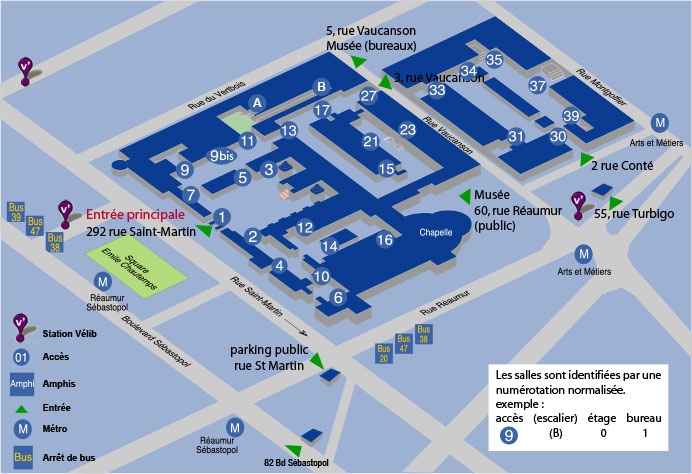
    Entrée CNAM : 292 rue Saint Martin, puis accès 21 :
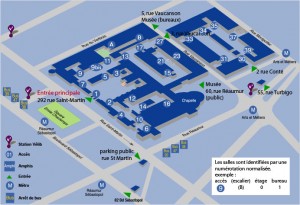
    Plan d'accès au Cnam

    Plan d’accès au Cnam


    Inscription

    Pour faciliter l’organisation, merci de bien vouloir nous indiquer votre présence par mail à l’une des deux adresses suivantes (sans espace) avant le 28 février 2016 :
    dicen . erecolnat @ gmail . com
    lisa . chupin @ cnam.fr

     

    Nouveaux Espaces de travail – Ville Numérique – Open Data : UNIVCAMP édition 2015


    UNICAMP édition 2015 :

    2 jours pour fabriquer
    ensemble la société nouvelle société collaborative


    Professionnels, académiques, chercheurs et étudiants, venez chercher et trouver ensemble, dans un temps limité, des solutions aux questions posées par la nouvelle société collaborative. En s’appuyant sur toutes les compétences en présence, UNIVCAMP permet, en une journée, de transformer les idées en projets jusqu’à la conception de maquettes de produits ou de services en s’appuyant sur toutes les compétences en présence..

    Thèmes de l’édition 2015 :

    Mercredi 15 avril Jeudi 16 avril
    • #Bureau du futur : L’innovation technologique transforme les espaces de travail et les campus universitaires !
    • #Gare 2.0 : Et si votre gare se transformait aussi en lieu de travail, de services et d’échanges !
    • #Télécentres et coworking : de nouveaux espaces dans les territoires, regroupant animations et services innovants?
    • #ville numérique : L’innovation numérique est- elle toujours au service de la ville de demain ?
    • #open data : Quels outils d’aide à la décision pour l’aménagement des territoires à base de données ouvertes.

    Depuis 4 ans, les Masters MIPI (immobilier d’entreprise) et MITIC (technologies de l’information) organisent à l’UNIVersité le barCAMP UNIVCAMP.

    Dans l’édition 2015, avec 5 ateliers collaboratifs UNIVCAMP est l’occasion :

    • D’explorer les nouveaux horizons de la ville de demain,
    • D’exploiter le gisement des open data,
    • D’imaginer les nouveaux espaces et modes de collaboration au travail.

    UNICAMP des Masters Mipi-Mitic offre une expérience intense de la collaboration tout azimut dans un esprit créatif, ouvert et concret.

    MERCI DE VOUS INSCRIRE SUR LE SITE : http://www.univcamp.fr/
    @Univcamp


    En partenariat avec le laboratoire Dicen-idf, le Syntec numérique sur l’Atelier « ville numérique », SNCF Développement, IT77 et la direction immobilière de l’université sur les ateliers concernant les espaces de vie/espaces de travail, la CCI du 77 et le SAN du Val d’Europe pour Open data


    C. Meyer, S. Mercier, I. Fasshauer,  C. Bourret, membres de Dicen-idf

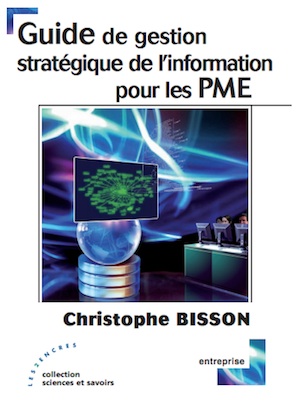
    Livre « Guide de gestion stratégique de l’information pour les PME », Christophe Bisson

    guide-gestion-info-pme-christophe-bissonLes PME sont aujourd’hui les principaux moteurs de l’économie, en France comme dans le monde. Ces acteurs de l’économie évoluent dans un environnement compétitif de plus en plus féroce marqué par le changement permanent comme seule certitude. De plus, ils doivent faire face à la mondialisation avec des moyens limités par rapport aux grandes entreprises. Les PME ont donc besoin d’exceller dans la gestion stratégique de leur information, ce qui constitue l’Intelligence Économique.

    La France gagnerait à séparer la sécurité de l’IE car bien souvent, la sécurité prend le dessus sur l’aide à la décision. De plus, cela entraine des biais de perception. En France, l’IE est à tort fréquemment assimilée à de l’espionnage. C’est la pire erreur qu’on puisse faire (Prescott, 1999), cette assimilation dessert profondément les entreprises, elle incite notamment les entrepreneurs des PME à se détourner de l’IE. La veille est un concept dépassé (Wright, 2012), et le seul moyen d’être compétitif est de développer des outils plus amonts qui permettent de réellement anticiper et de créer une Intelligence Collective.

    Pour découvrir les préfaces de l’ouvrage  => 

    Préfaces

    PrefacesGuide
    Titre: PrefacesGuide (0 clic)
    Légende:
    Nom du fichier: prefacesguide.pdf
    Taille: 36 Ko

    Pour le commander  : www.strategic-warnings.fr

    Christophe Bisson est enseignant-chercheur en Intelligence Économique et Système d’Information Stratégique à l’Université de Kadir Has, Istanbul. Il enseigne en MBA à l’Université de Bogazici (première université turque pour les sciences sociales) et est membre associé du laboratoire de recherche DICEN-IDF (Paris).

    Wikipédia : objet scientifique non identifié


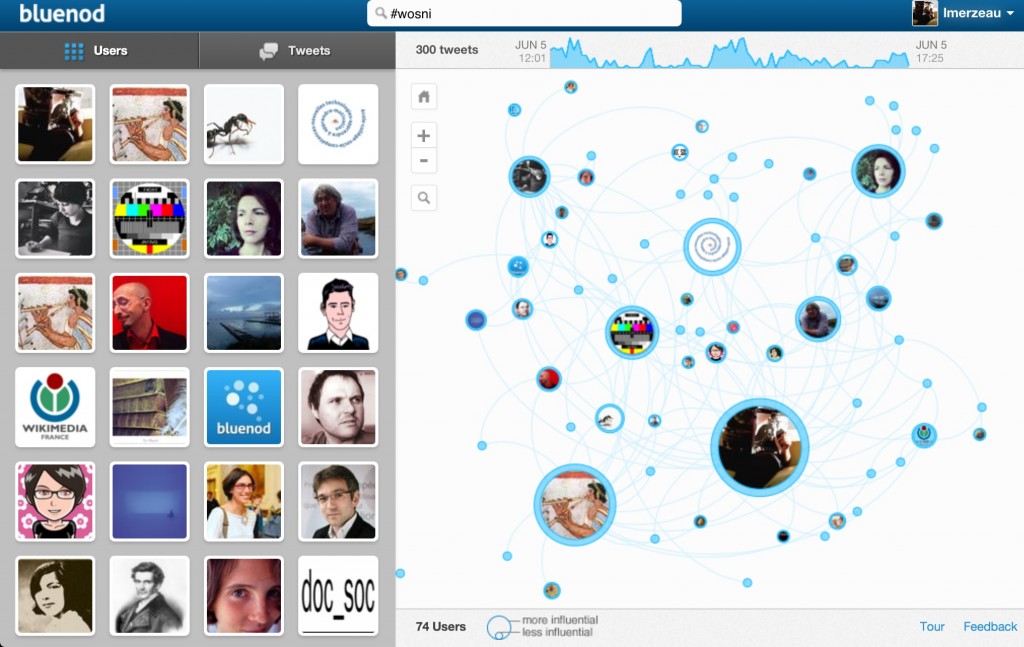
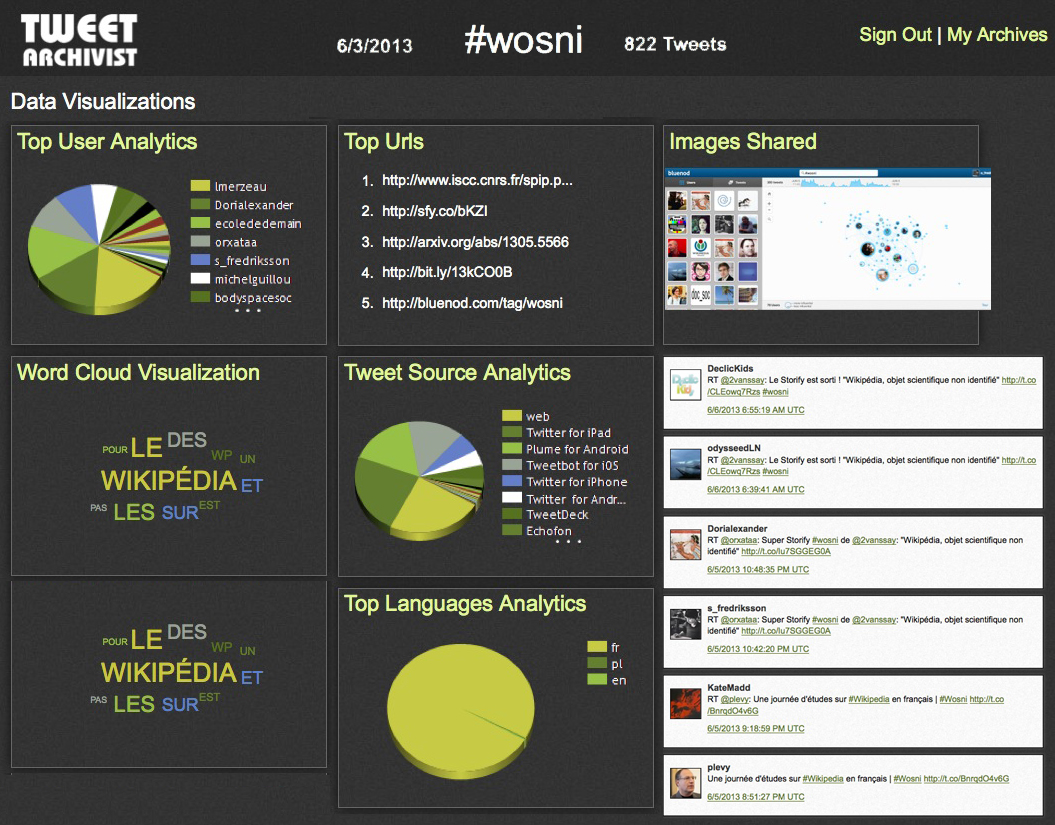
    Visualisation de la communauté #wosni sur Twitter par Bluenod

    5 juin 2013  9h-18h

    Institut des Sciences de la Communication du CNRS (ISCC)
    20 rue Berbier-du-Mets – 75013 Paris
    Entrée libre sur inscription (capacité limitée à 60 personnes) :
    lionel.barbe@u-paris10.fr et valerie.schafer@iscc.cnrs.fr

    Projet WEUSC (Wikipédia : évaluation et usages des savoirs collaboratifs)
    porté par Lionel Barbe (MCF, Université Paris Ouest Nanterre La Défense, laboratoire Dicen-IDF, équipe Tactic)
    Programme financé dans le cadre des Projets Exploratoires en Sciences de la Communication du CNRS

    Cette journée souhaite analyser les rapports que scientifiques et sciences entretiennent avec Wikipédia autour de trois problématiques :

    • la place de l’expertise et celle du chercheur contributeur ou expert dans Wikipédia ;
    • celle de la gouvernance de Wikipédia, de ses régimes d’édition, de ses enjeux de neutralité, de ses sources ;
    • celle enfin de Wikipédia comme objet de recherche, de corpus ou terrain d’analyse.

    Les sciences dans Wikipédia, Wikipédia dans les sciences… un programme de journée “librement distribuable que tout le monde peut améliorer”… le jour même en contribuant directement aux discussions et via Twitter (mot-dièse #Wosni).

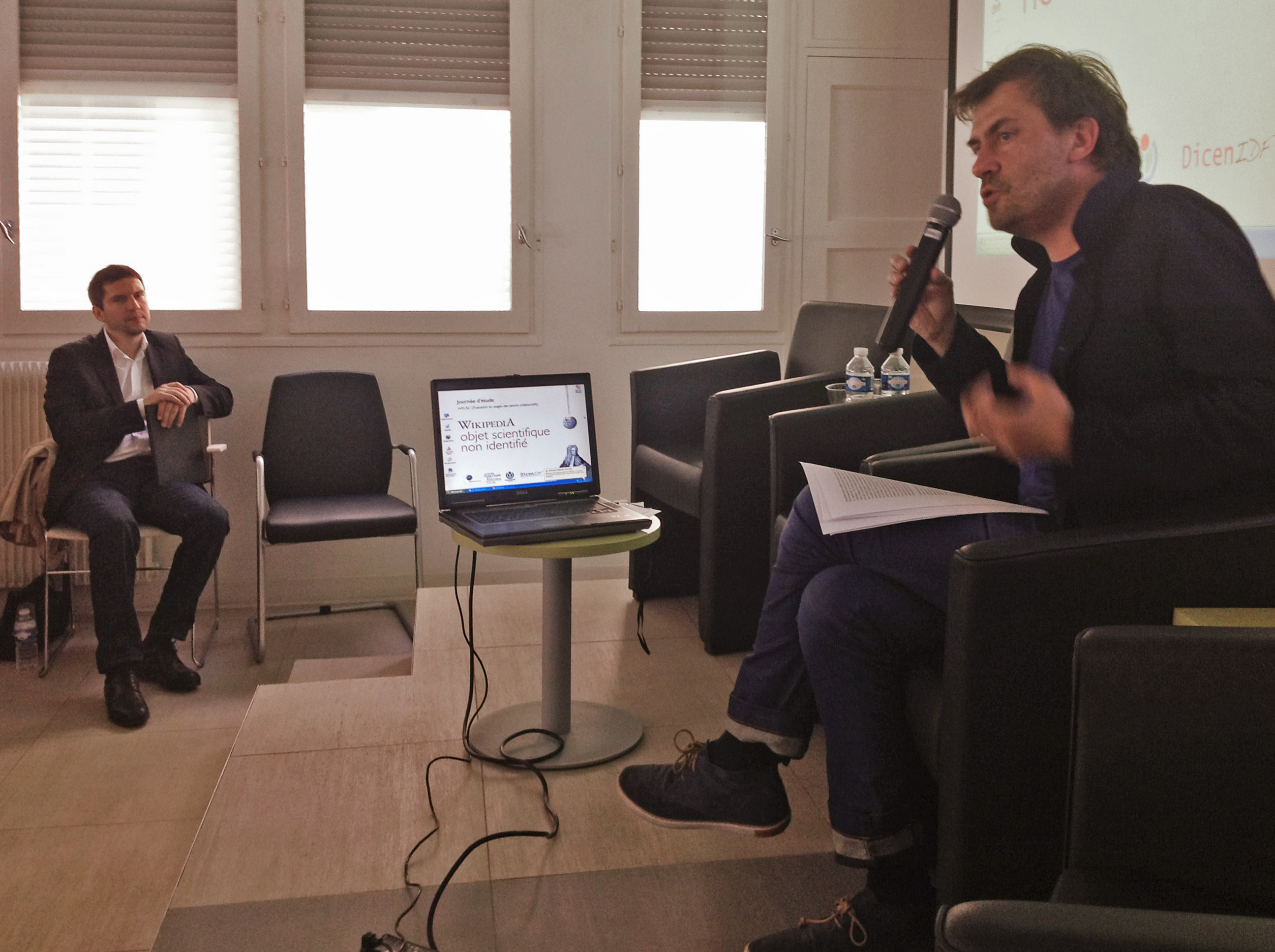
    Antonio Casilli  Dominique Cardon
    Antonio Casilli et Dominique Cardon – Photo Louise Merzeau CC BY-NC-SA

    Programme

    Matinée

    • 9h00 > 9h15 : Lionel Barbe (MCF en SIC, Université Paris Ouest Nanterre La Défense, Dicen-IDF – Tactic) : Introduction de la journée
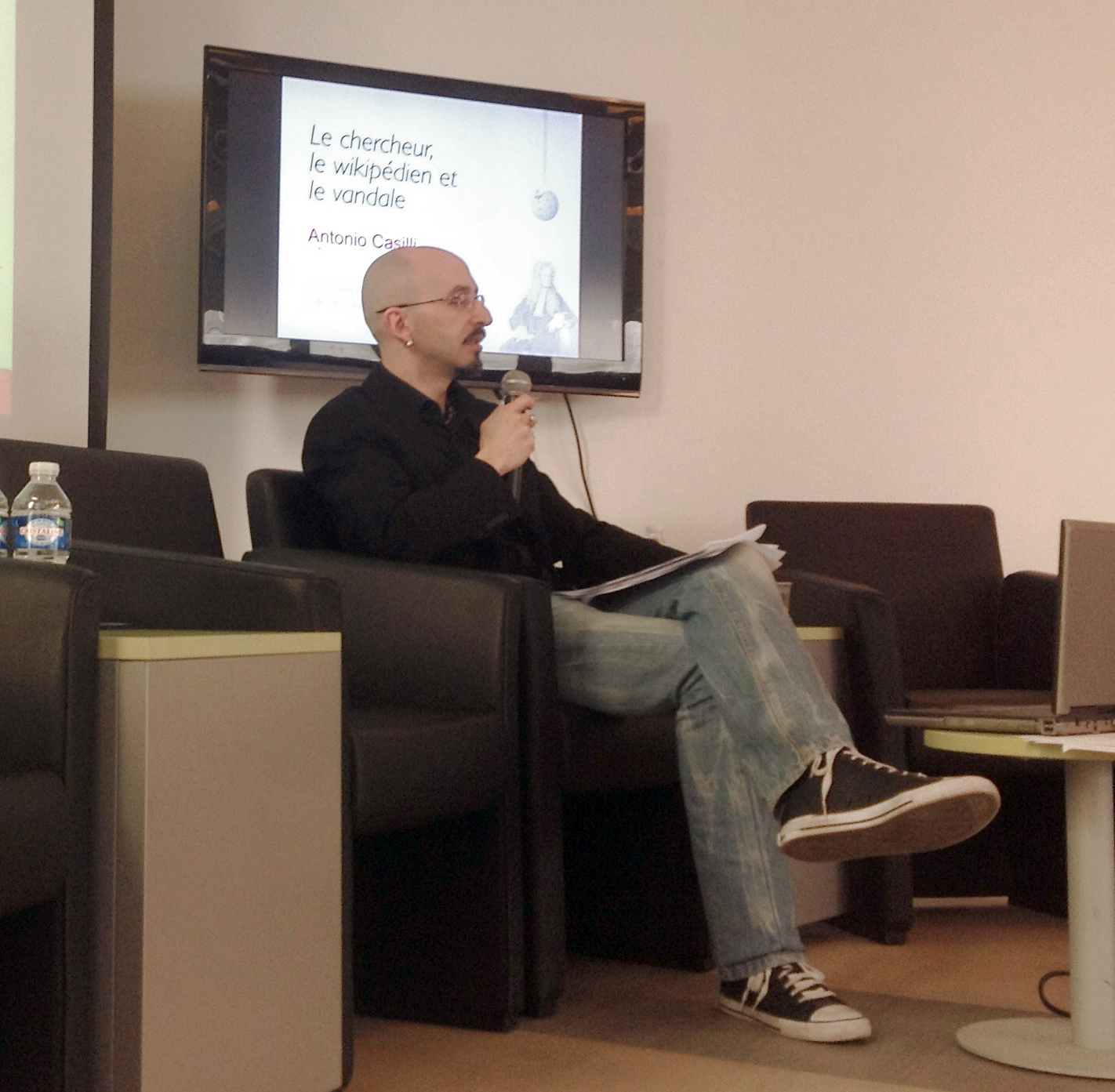
    • 9h15 > 9h35 : Antonio Antonio Casilli (MCF Télécom ParisTech – chercheur Centre Edgar-Morin EHESS) : Le chercheur, le wikipédien et le vandale


    Antonio Casilli par Revue-HERMES

    • 9h40 > 10h00 : Evelyne Broudoux (MCF en SIC, Cnam, Dicen-IDF) : Recherches sur Wikipedia : un état de l’art
    • 10h00 > 12h30 : 1re table ronde : Place(s) et statut(s) des experts
      Modération : Louise Merzeau (MCF-HDR en SIC, Université Paris Ouest, Dicen-IDF – Tactic)
      Avec :

    –     Jean-Lou Justine (Professeur, Muséum National d’Histoire Naturelle) : Wikipédia, Wikimédia, Wikispecies et la parasitologie : le témoignage d’un chercheur « expert », mais débutant dans Wikipédia ;

    –     Régine Fabri (Chef de travaux, gestionnaire de la bibliothèque du Jardin botanique national de Belgique) : Chercheur en botanique, contributeur et utilisateur de Wikipédia, un défi à relever;

    Pause

    –     Alexandre Moatti (Ingénieur en chef des Mines, chercheur associé à Paris-VII) : Les postures d’opposition à Wikipédia en milieu intellectuel et culturel ;

    –     Carol Ann O’haré (Chargée de la mission recherche et enseignement, Wikimedia France) : La place des chercheurs et des experts dans Wikipédia ;

    –     Gilles Sahut (PRCE documentation, IUFM Midi-Pyrénées, Université de Toulouse 2, Laboratoire d’études et de recherches appliquées en sciences sociales) : Les étudiants face aux incertitudes de l’édition collaborative : enquête sur les opinions et connaissances informationnelles à propos de Wikipédia.

    Discussion

    • 12h30 > 14h00 : Pause déjeuner


    Carol Ann O’haré, Pierre Carl Langlais – Photo Louise Merzeau CC BY-NC-SA

    Après-midi 

    Animation : Mélanie Dulong de Rosnay (Chargée de recherche, ISCC)

    • 14h15>14h45 : La gouvernance de Wikipédia, par Dominique Cardon (Directeur de recherche, Orange Labs)


    Dominique Cardon par Revue-HERMES

    • 14h45>16h00 : 2e table ronde : Gouvernance de Wikipédia
      Modération : Valérie Schafer (Chargée de recherche, ISCC)
      Avec :

    –     Pierre Carl Langlais (Doctorant en science de l’information et de la communication attaché au GRIPIC, Paris-IV) : {{Référence nécessaire}} – genèse d’une norme wikipédienne (2003-2009), par ;

    –     Pierre Willaime (Doctorant, laboratoire d’Histoire des Sciences et de Philosophie Archives Henri Poincaré, UMR 7117 CNRS / Université de Lorraine) : Quelle expertise pour Wikipédia ? ;

    –     Alexandre Hocquet (Professeur, Université de Lorraine) :Wikipédia en tant que forum : une analyse ethnographique de la production d’articles.

    Discussion

    Pause


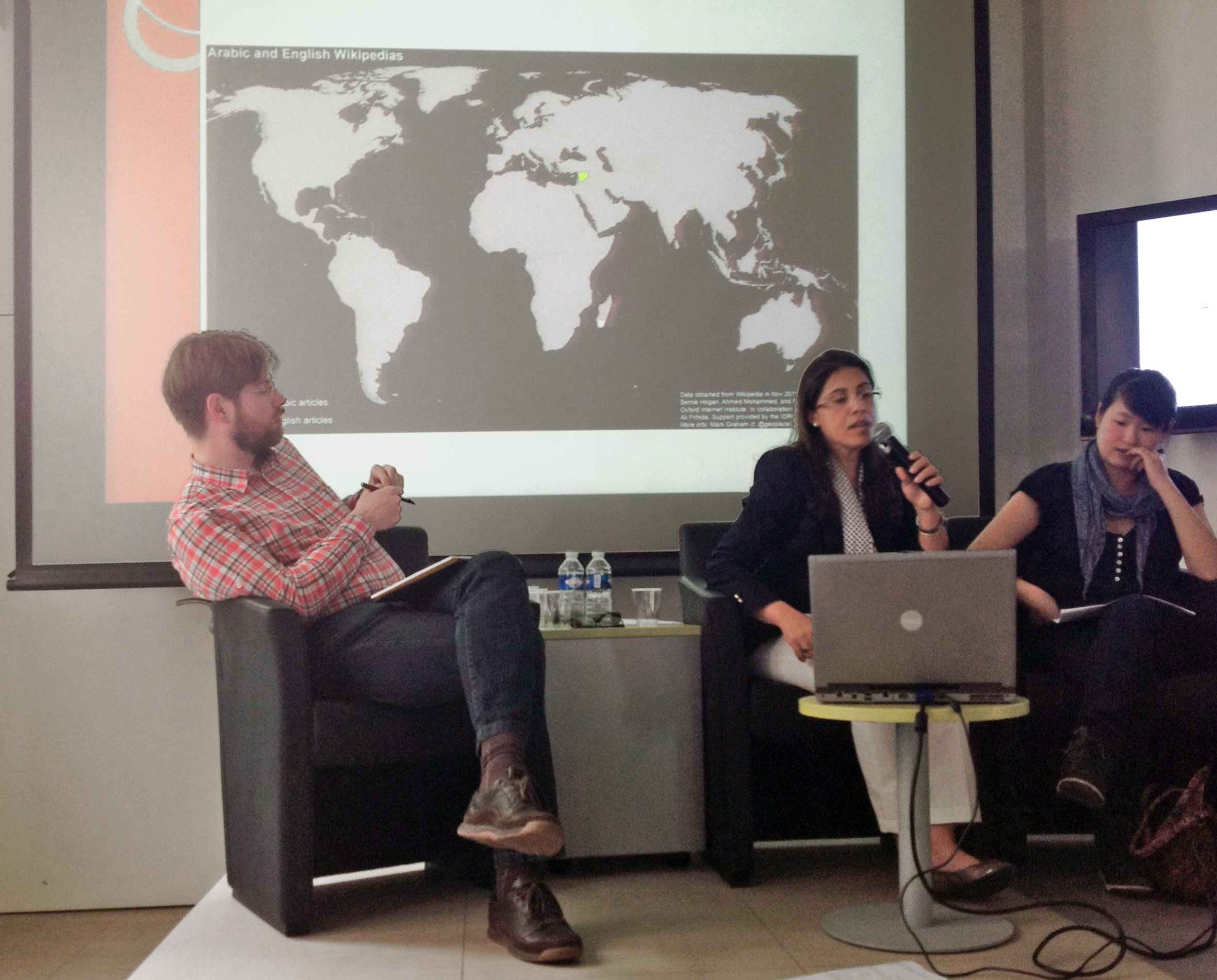
    Robert Viseur, Ilhem Allagui, Celine Poudat – Photo Louise Merzeau CC BY-NC-SA

    • 16h15>17h45 : 3e table ronde : Corpus et terrains
      Modération : Camille Paloque-Berges (Chercheuse, Dicen, Cnam)
      Avec :

    –     Célilne Poudat (Maître de conférences, Université Paris XIII, laboratoire LDI) : Wikipédia comme corpus. Présentation des travaux du groupe NouvCom et du projet CoMeRe de l’IR Corpus écrits ;

    –     Ilhem Allagui (Professeure- Université Américaine de Sharjah- Emirats Arabes Unis) : Wikipedia Arabe: Cartographie, Enjeux et Perspective ;

    –     Robert Viseur, (Ingénieur de recherche Senior CETIC, Charleroi, Assistant, Faculté Polytechnique UMONS) : Collecter des données sur Wikipédia: application à la création d’une base de données biographiques.

    Discussion

    • 17h45>18h00 : Lionel Barbe : Conclusion de la journée

    Comité scientifique :

    • Lionel Barbe (Maître de conférences, Université Paris Ouest Nanterre La Défense, Dicen-IDF, Tactic)
    • Evelyne Broudoux (Maître de conférences, Cnam, Dicen-IDF,)
    • Dominique Cardon (Directeur de recherche, Orange Labs)
    • Régine Fabri (Chercheuse, National Botanic Garden of Belgium)
    • Hervé Le Crosnier (Maître de conférences HDR, Université de Caen, ISCC)
    • Mélanie Dulong de Rosnay (Chargée de recherche, ISCC)
    • Alain Lelu (Professeur, Université de Franche Comté, ISCC)
    • Louise Merzeau (Maître de conférences HDR, Université Paris Ouest Nanterre La Défense Dicen-IDF, Tactic)
    • Camille Paloque-Berges (Chercheuse, Cnam, Dicen-IDF)
    • Jacques Perriault (Professeur émérite, Université Paris Ouest Nanterre La Défense, Dicen-IDF, Tactic – ISCC)
    • Valérie Schafer (Chargée de recherche, ISCC)

    Télécharger le programme en pdf

    Texte de l’appel à communication